Tom Milton
Where the Crawdads SingTom Milton, a seventy-one-year-old lawyer who has retired from practice, comes back to defend Kya Clark when she faces a first-degree murder charge and the possibility of the death penalty. He becomes more than her courtroom representative: by learning how to communicate with a defendant who initially will not speak to him, and by confronting the community’s treatment of her before the jury, he makes the trial address both the charge and the isolation that shaped Kya’s life.
Identity and decision to defend Kya
Judge Harold Sims had appointed a young attorney to represent Kya, who had taken no steps to choose counsel herself. When Tom heard about the case, he came out of retirement and requested to represent her without charge. His decision brings an experienced, self-directed advocate into a case whose defendant is so withdrawn that even arranging a conversation proves difficult.
Tom knows Kya first through the town’s reputation and his occasional glimpses of her. He has heard stories about the Marsh Girl and seen her moving through the waterways or hurrying away from the grocery. The narration recalls that he once perceived her through the town’s distancing images—as part of the current, or as an animal darting from rubbish. That history gives his later defense a particular tension: he is not presented as someone who never encountered the stigma, but as a lawyer who comes to challenge its consequences in court.
Reaching his client in jail
At their first meeting, Tom introduces himself and explains that he will represent Kya. She does not look up, answer, or respond to his questions. He feels an impulse to reach out, but her rigid posture and vacant stare hold him back. He explains the court process and what she should expect, yet the meeting yields no exchange. When she is led away, she looks through a small window toward the sky and listens to seabirds over the harbor; Tom has not yet found a way to make legal explanation meaningful to her.
For his next visit, he brings a glossy book titled The Rarest Shells of the World, with life-sized paintings of shells from distant shores. Kya turns its pages slowly and nods at particular specimens. Tom does not hurry her. Once she looks into his eyes, he explains the proceedings again, this time drawing the courtroom and marking the jury box, judge’s bench, and places where the lawyers and Kya will sit. He adds figures for the bailiff, judge, and recorder, explaining their roles. The drawings make an unfamiliar institution visible in a form she can follow.
Tom also tries to discuss the evidence and ask where Kya was on the night Chase died. At any mention of such details, she retreats into silence. When she slides the book back as he prepares to leave, he tells her to keep it: he had brought it for her. Her bitten lip and blinking eyes register a response, though she still does not give him an account of the night. His effort is therefore both practical and relational: he builds a channel of attention without claiming that trust has already become testimony.
The trial and its limits
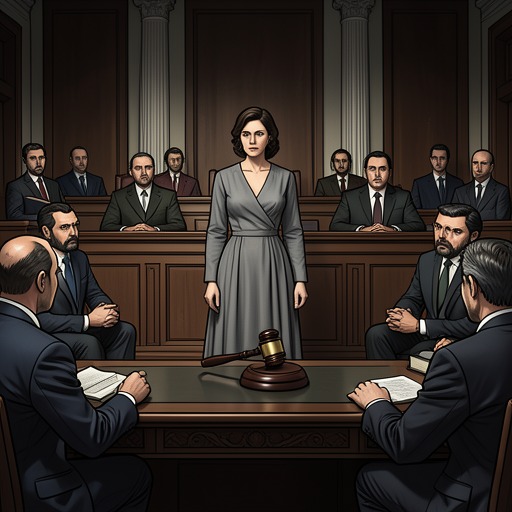
On the morning the trial opens, Tom tries to use the courtroom drawing again to distract Kya from the crowd gathered behind them. The tactic does not ease her distress. She has spent two months in dimness and is now brought into the bright courtroom in handcuffs; Tom’s quiet reassurance cannot remove the strain of the scene. He stays close, and she does not refuse that comfort.
Before the trial proceeds, Tom asks Judge Sims to move it to another county, arguing that prejudice in the community will prevent a fair hearing. The judge denies the motion. He acknowledges that Kya has lived in unusual circumstances and experienced prejudice, but says the court has not been shown that her treatment exceeds that of many defendants in small towns. The ruling leaves Tom to defend her before the same local audience whose stories and labels have helped define her public identity.
The courtroom itself is crowded with villagers, journalists, and spectators eager to hear about the evidence and the possible death penalty. Its customary arrangement restricts Black spectators to a rear balcony, which is mostly occupied by white people during Kya’s trial. Tom must therefore make his case within a civic setting marked not only by gossip about the Marsh Girl but also by racial segregation. He cannot move the trial away from that setting; his work must proceed inside it.
Challenging the case and addressing the jury
In questioning Sheriff Ed Jackson, Tom focuses on the absence of physical evidence and on the investigation’s treatment of footprints. He asks whether anyone sought expert examination for footprints or signs that they had been wiped away, and whether there were marks, disturbed mud, or photographs indicating that tracks had been covered. The sheriff answers that he considered himself qualified through his official training and had not needed another expert. Tom’s questions expose a distinction between evidence that investigators actually examined and conclusions they assumed their expertise allowed them to draw.
In his closing address, Tom directly takes up the name the town has given Kya. He tells the jury that he grew up in Barkley Cove and heard the tales about the Marsh Girl, including claims that she was less than fully human. He replaces those rumors with the account of an abandoned child surviving hungry and cold, and asks the jury to consider the community’s part in making her an outsider. He points to the lack of help from churches and community groups and identifies Jumpin’ as one of her few friends who did help her. His argument does not merely ask the jury to disregard the label; it asks them to see how exclusion produced the difference the town then treated as proof of otherness.
Acquittal and personal aftermath
The jury finds Kya not guilty of first-degree murder. Tom’s defense has taken place under the threat of a death sentence, before a packed courtroom, after the judge refused to transfer the case. The verdict frees her, and Judge Sims apologizes on behalf of the state for the two months she spent in jail. The result does not erase the detention or the community’s hostility, but it ends the prosecution without a conviction.
After the verdict, Kya thanks those who came to support her. When she turns to Tom, she loses her words, and he answers by enfolding her in his arms. The gesture completes a relationship begun in the jail visits: at first she could not meet his eyes or answer his questions; by the end, she can offer gratitude even when speech fails. Tom’s role in the story rests on this combination of legal advocacy and patient human contact. His defense makes the jury confront the gap between the town’s stories about Kya and the abandoned child those stories had helped leave alone.